
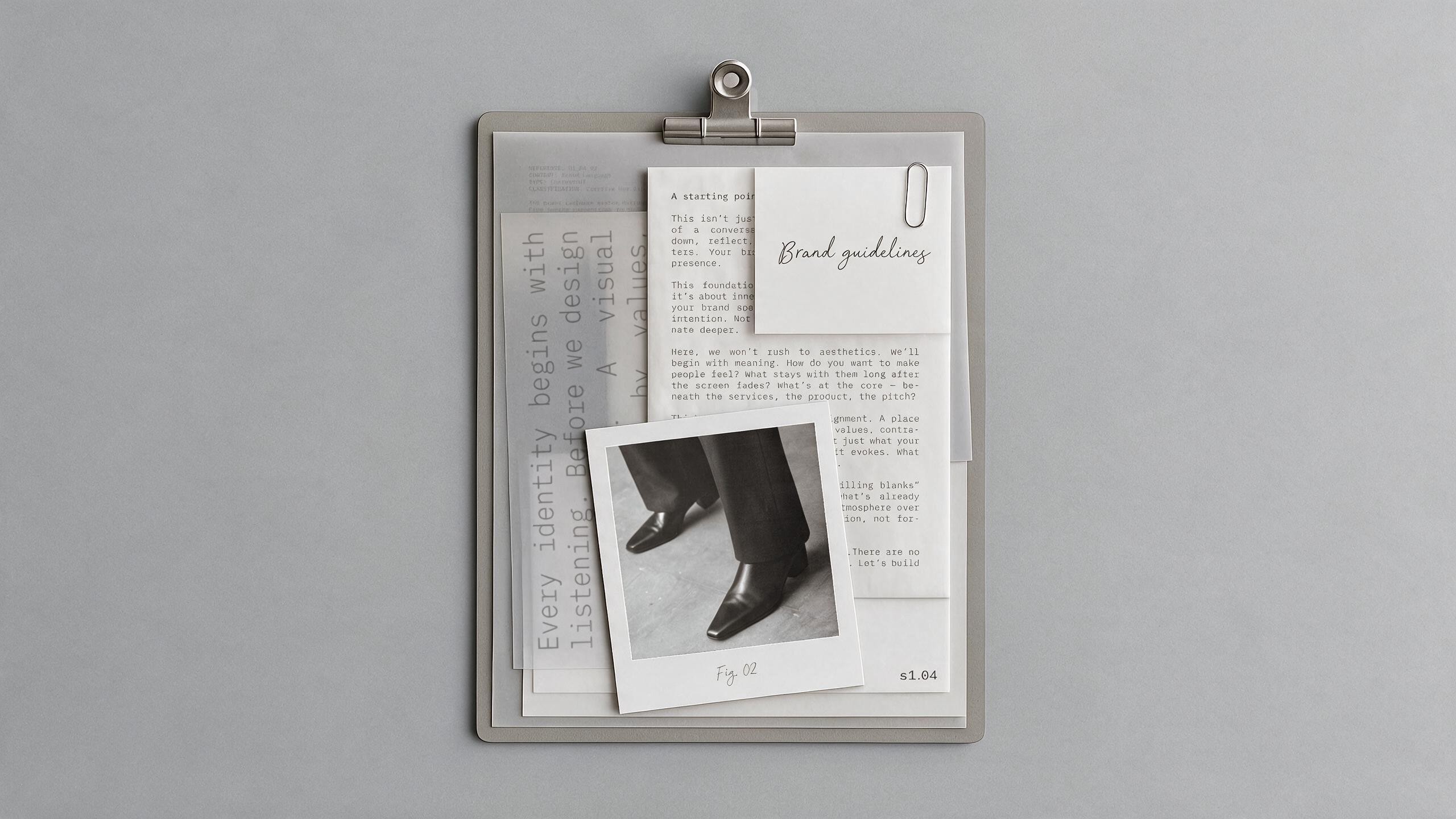
Guidelines nobody reads are guidelines that failed

Guidelines nobody reads are guidelines that failed

Guidelines nobody reads are guidelines that failed

4

min
read

Process

·

Feb 9, 2026

We used to ship forty-page brand books. Now we ship twelve pages and test them on someone who has never opened a design tool. What changed, what we cut, and why the real measure of a system is whether it survives a Tuesday morning without us.

Talvinder Gray

Content Systems Lead

·

Alta®

Forty pages, never opened.

Brand books have grown into documents that impress in a presentation and go unopened afterwards. Length reads as thoroughness, thoroughness reads as value, and the incentive to add pages is much stronger than the incentive to remove them.

The reader we imagined was a designer with an afternoon. The reader we actually have is a marketing coordinator with fifteen minutes and a post to publish. Almost every page written for the first reader is invisible to the second.

Write for non-designers.

A guideline competes with guessing, and guessing is fast. If finding the answer takes longer than inventing one, people will invent one, and the brand drifts by a hundred small improvisations rather than one big violation.

This makes findability the primary design constraint, ahead of completeness. A twelve-page document that answers the eight most common questions immediately will outperform a forty-page document that answers forty questions slowly, every time.

Twelve pages, tested.

Cut the document to the decisions people actually face, then watch someone unfamiliar try to use it while you say nothing. Their hesitations are your table of contents, and their wrong turns are your rewrite list.

Lead with worked examples rather than principles. People pattern-match faster than they parse, and a correct example beside an incorrect one teaches a rule in seconds that a paragraph fails to teach at all.

Unread is unfinished.

A guideline is not a deliverable, it is an instruction that either works or does not. Judging it by its thoroughness is like judging a sign by its word count.

If nobody opens it, we did not finish the job. That standard is uncomfortable because it moves the measure of success past the handover call, where most studios stop looking.

Cut it in half, then again.

Put the most common question on page one, and anything requiring design vocabulary either gets rewritten in plain language or removed. If a rule cannot be explained without jargon, it is probably a preference rather than a rule.

Keep a living list of every question a client asks after handover. That list is the next version of the document, and it is more accurate than any structure you could plan in advance.

Write it to be used.

Nobody has ever praised a brand book for its length. They praise it when they find the answer in under a minute and get on with their day.

We ship twelve pages now. The brands hold better than they did at forty.

Stay connected.

Explore more of what we do. Follow us on Twitter, Instagram and Facebook

More Blogs.

More Blogs.

More Blogs.

Whether it's a new identity, a campaign shoot, or a brand film. It starts with one call.

Caprice Kim

Founder & creative director

·

Alta®

Newsletter

Subscribe for launches, writing, and the occasional honest opinion. No trends.

Whether it's a new identity, a campaign shoot, or a brand film. It starts with one call.

Caprice Kim

Founder & creative director

·

Alta®

Newsletter

Subscribe for launches, writing, and the occasional honest opinion. No trends.

Whether it's a new identity, a campaign shoot, or a brand film. It starts with one call.

Caprice Kim

Founder & creative director

·

Alta®

Newsletter

Subscribe for launches, writing, and the occasional honest opinion. No trends.

FAQ

The questions every client asks before starting
answered straight.

More questions?

Contact us and let's talk

How does the retainer actually work?

You get a monthly block of studio hours and a request queue. We work one request at a time (two on Pro), send progress every 48 hours, and revise until it's right. No scoping calls for every task — you brief, we build.

What's the difference between Standard and Pro?

Hours and speed. Pro carries 70 hours to Standard's 45, runs two requests in parallel, gets priority scheduling, and includes a monthly shoot day in-studio.

Can I pause my retainer?

Anytime. Unused days roll over, and you resume exactly where you left off. There's no minimum term.

What if the first month isn't working out?

If the first week doesn't deliver, the rest of the month is refunded. We'd rather earn the retainer than hold you to it.

Do you work with remote clients?

Yes — most projects run fully remote with weekly review calls. Shoots happen in our studio or on location; product can be shipped to us.

What do we receive at handover?

Everything: source files, brand guidelines, edited imagery, editable templates, and a walkthrough call with your team. The goal is that you don't need us for daily work.

FAQ

The questions every client asks before starting
answered straight.

More questions?

Contact us and let's talk

How does the retainer actually work?
What's the difference between Standard and Pro?
Can I pause my retainer?
What if the first month isn't working out?
Do you work with remote clients?
What do we receive at handover?